
Why Your Bathroom Extractor Fan Stops When the Light Turns Off (And Why It's Causing Mould)
Last Tuesday morning,
I got a call from a woman in Sydenham. Black mould was spreading across her bathroom ceiling like a disease.
She'd already spent £800 having it treated twice by a "specialist." It kept coming back.
When I walked into that bathroom, I knew what the problem was before I even looked up. Her extractor fan stopped the instant she turned the light off.
I've seen this exact problem hundreds of times over twenty years. It's one of the most common bathroom mistakes, and it's costing people thousands in mould treatment that doesn't actually work.
Let me tell you what's really happening, why most installations get this wrong, and how to fix it properly.
What's actually happening
(The simple truth)
Here's what I explain to every customer:
When you shower, you create about 1.5 litres of moisture. That's nearly two full water bottles worth of steam floating around your bathroom. That moisture needs to go somewhere.
If your fan works properly, it pulls that steam outside before it can condense on your cold ceiling. If your fan stops when you turn the light off, that moisture has nowhere to go except onto your surfaces.
Think about what you actually do. You finish showering. You turn the light off. You leave. The room is still full of steam—mirror fogged, windows wet, warm moisture rising to the ceiling.
Your fan just stopped. That steam sits there for the next hour, condensing on the coldest surface it can find.
Usually your ceiling.
Sometimes your corners.
Always somewhere you'll see black spots in about six weeks.
When I was younger, working on luxury hotels during my advanced maintenance training, my supervisor and mentor Sir John used to say:
"There’s no need to rush. When you give a job the attention it deserves, you build trust and show real expertise. That’s what sets true professionals apart.”
He was talking about taking pride in work. Installing a timer fan costs £40 more than a basic fan.
That £40 is the difference between proper work and a phone call six months later when mould appears.
I learned that lesson fixing my own mistakes early on. I don't make that mistake anymore.
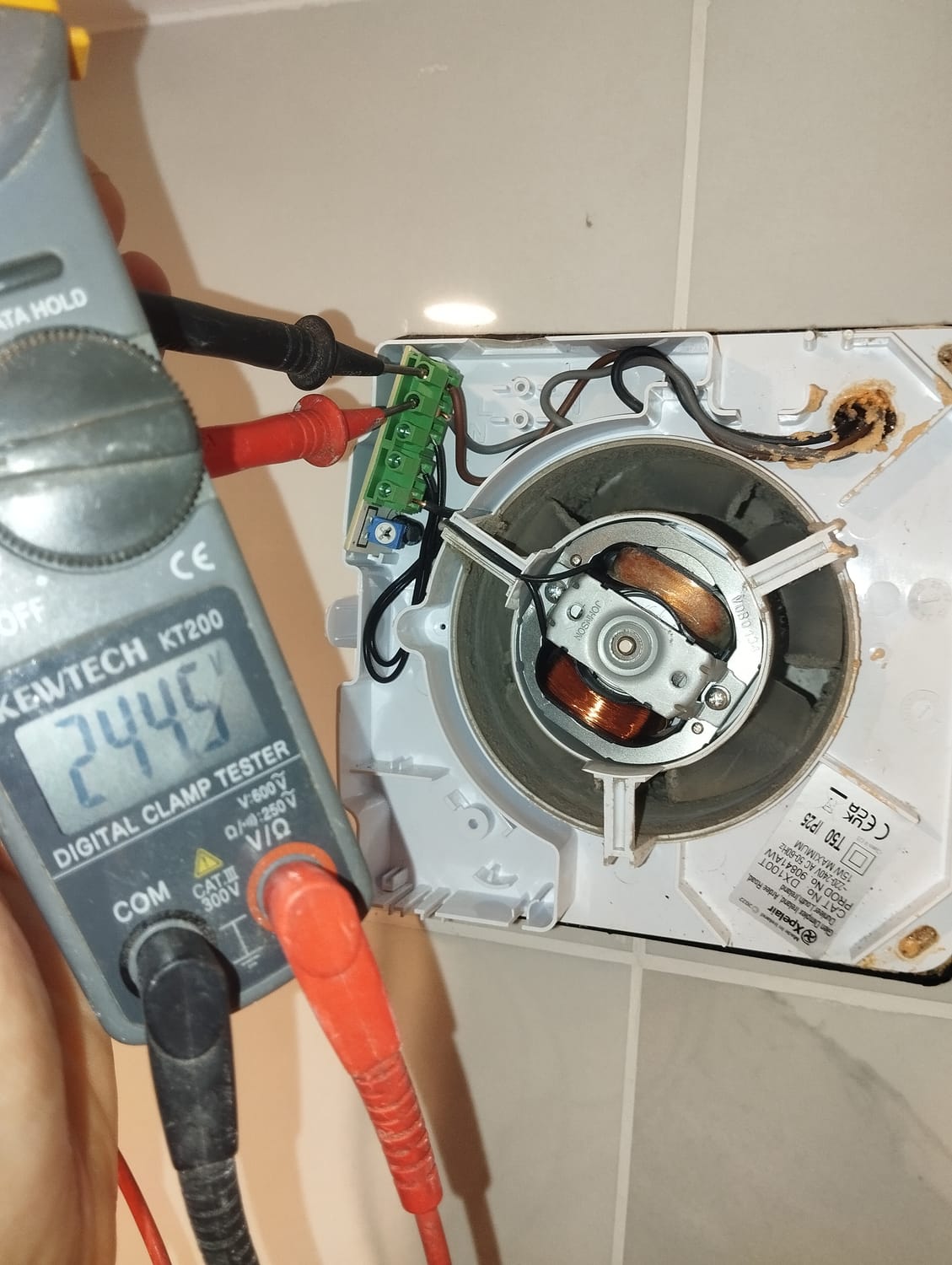
The 2 types of fans
(And why most people buy the wrong one)
After installing probably 500+ bathroom fans over twenty years, here's what actually works:
Basic Extractor Fan (The One That Causes Problems)
How it works: Wired directly to your light switch
What happens: Runs when light is on, stops when light is off
Cost: £15-35
Installation: Simpler (one wire to light switch)
The problem: Stops before moisture is removed
I installed dozens of these when I was starting out. I thought I was doing good work. Every single one ended up with mould complaints within a year. Every. Single. One.
Example of what NOT to buy:
Manrose CF100T Basic Fan (£22 on Amazon)
Extract rate: 16 litres/second
Runs with light only
No timer, no humidity sensor
Will cause mould in most bathrooms
The only time a basic fan works is if you have a massive openable window that you actually open after every shower. And let's be honest—in February in London, nobody's doing that.
Timer Extractor Fan (The One That Actually Works)
How it works: Runs for 15-30 minutes after you turn the light off
What happens: Actually removes moisture after you've left
Cost: £35-85
Installation: Slightly more complex (needs permanent live wire)
The reality: No mould, no problems, no call-backs
What I actually install now:
Budget Option:
Manrose MF100T Timer Fan (£42 on Amazon)
Extract rate: 17 litres/second
Adjustable timer (15-30 minutes)
Backdraft shutter included
Quiet operation (26dB - whisper quiet)
Easy timer adjustment with screwdriver
This is what I fit in 60% of bathrooms
Premium Option:
Vent-Axia Silhouette 100XT (£85 on Amazon)
Extract rate: 20 litres/second
Built-in humidity sensor (turns on automatically when humid)
Adjustable timer (15-30 minutes)
Ultra-quiet (23dB - silent)
5-year warranty
This is what I fit when customers want the best
High-End Option:
Vent-Axia Lo-Carbon Sentinel Kinetic (£165 on Amazon)
Extract rate: 25 litres/second
Humidity sensor + presence sensor
Intelligent control (learns your patterns)
Energy efficient motor
App control available
This is what I fit in new builds or high-end renovations
The difference between the £42 fan and the £165 fan?
The cheap one does the job perfectly well. The expensive one does it with more features and lasts longer. Both prevent mould.
Both are better than any basic fan.
Building regulations
(What the law actually says)
This is where it gets interesting. Most people don't know the law requires proper ventilation.
Building Regulations Part F (Ventilation) states:
For bathrooms WITH an openable window:
Minimum 15 litres/second extract rate
OR window that opens to at least 1/20th of floor area
For bathrooms WITHOUT a window (internal bathroom):
Minimum 15 litres/second continuous extract
OR 60 litres/second intermittent with 15-minute overrun timer
That "15-minute overrun" means the fan must keep running after you leave. It's not optional for windowless bathrooms. It's the law.
I see this mistake constantly. DIY person or cheap electrician installs basic fan, wires it to light switch, jobs done.
Except it's not compliant. And more importantly, it doesn't work.
One of my early mentors used to tell me:
"Always assess the space by your view and experience, and act on base of that. Because if things go wrong, this is your fault—not the person who just told you what to do."
He meant: if a customer asks for a basic fan in a windowless bathroom, you explain why that's not going to work.
Don't just do what they ask because it's easier. Do what's right.
I've learned to have that conversation upfront now. "You can have the £20 fan that'll need replacing when mould appears in six months, or the £45 fan that'll work properly. Your choice."
Nobody chooses the cheap one when you explain it like that.
Why most installations fail
(The 5 common mistakes)
I've fixed enough of these to write a book.
Here are the exact mistakes I see repeatedly:
Mistake 1: Fan connected directly to light switch
What happens: Fan only runs when light is on
Who does this: 70% of DIY installations, 40% of "electricians"
The result: Mould within 3-6 months
The fix: £120-150 to install timer fan properly
Story: A landlord in Dulwich called me about mould in three rental properties. All three had basic fans wired to lights. I replaced all three with timer fans in one day. Cost him £450 total. No more mould complaints in 18 months since.
He could've saved £450 if the original electrician had spent £40 more per fan in the first place.
Mistake 2: Timer set too short
What happens: Fan runs for 5 minutes when it needs 20
Who does this: Installers who set it and forget it
The result: Some mould, just slower
The fix: 2-minute adjustment with a screwdriver (free if you know how)
Most timer fans have a small dial or switch inside. You remove the cover, adjust the dial, job done. Takes 2 minutes if you know where to look.
But most people don't know it's adjustable. They assume 5 minutes is correct. It's not. For most bathrooms, 20 minutes is minimum.
Mistake 3: Wrong size fan for room size
What happens: Small fan in large bathroom can't move enough air
Who does this: People buying "whatever's cheapest"
The result: Inadequate ventilation, mould in corners
The fix: £350-£450 including correct fan
Rule of thumb:
Bathroom up to 4m²: 100mm fan (15 l/s minimum)
Bathroom 4-6m²: 100mm fan (17 l/s minimum)
Bathroom 6-10m²: 120mm fan (20+ l/s minimum)
Bathroom over 10m²: Consider two fans or 150mm fan
I saw a massive 19m² bathroom with ensuite in Norwood.
They'd installed one basic £20 fan. Mould everywhere bathroom and room. I installed one Turbo tube TT100PROT (300m3/h)
Problem solved.
Cost to do it wrong: £20
Cost to fix it: £440
Cost to do it right first time: £200
Mistake 4: Ducting done wrong
What happens: Duct kinked, too long, or venting into loft instead of outside
Who does this: DIY installations where cutting through wall looks hard
The result: No airflow, moisture in loft, or cold air flooding back
The fix: £200-400 depending on access
This was my mistake when I was 20"s. First solo bathroom job. I didn't want to core-drill through the brick wall, so I vented the fan into the loft. Thought I was being clever.
Three months later, customer calls. Loft insulation soaking wet. Mould growing on rafters. I had to come back, cut through the wall properly, replace £300 of insulation, and didn't charge the customer a penny extra.
That mistake cost me £600 and time and taught me a lesson I never forgot: do it properly or don't do it at all.
Mistake 5: No backdraft prevention
What happens: Cold air floods back through fan when it's not running
Who does this: Cheap fans without built-in shutters
The result: Cold bathroom, higher heating bills, draft
The fix: £80-120 to replace with proper fan
Good fans have a backdraft shutter—plastic flaps that close when fan isn't running. Cheap fans don't. You get a cold draft coming in.
Customer in Crystal Palace complained her bathroom was freezing. I looked at her fan. £15 basic model from eBay, no shutter. Wind was literally blowing straight through it.
Replaced with proper fan with shutter. Problem solved. She said heating bill dropped noticeably that winter.
Real Example: What actually happened
Mrs. Patel in Sydenham.
This is the woman I mentioned at the start.
Black mould covering 60% of her bathroom ceiling. She'd paid two different companies £400 each to treat it. It came back both times within six weeks.
When I looked, I could see everything wrong:
1. Basic £18 fan from Screwfix wired to light switch
2. Fan undersized (4m² bathroom, fan rated for 2m²)
3. Duct was kinked behind the fan (no airflow)
4. External grille had no cowl (wind pushing moisture back)
5. No timer, so ran for maybe 30 seconds total
I explained: "Your fan is doing almost nothing. Every shower creates 1.5 litres of moisture. Your fan runs for 30 seconds while you turn the light off. All that steam stays in here and condenses on your ceiling every single night."
She understood immediately. "Why didn't they just tell me that?"
Good question. Maybe they didn't know. Maybe they just wanted to sell mould treatment.
What I did:
Removed basic fan
Installed Manrose MF100T timer fan (£42)
Straightened the kinked duct
Added external cowl with backdraft shutter (£8)
Set timer to 20 minutes
Tested airflow (strong pull now)
Total cost: £180 including materials and labour
Time: 90 minutes
Six months later, she sent me photos. Ceiling completely clear. Not a spot of mould anywhere.
She'd spent £800 on treatments that didn't work. £180 to fix the actual problem.
That's why I tell people: treat the cause, not the symptom.
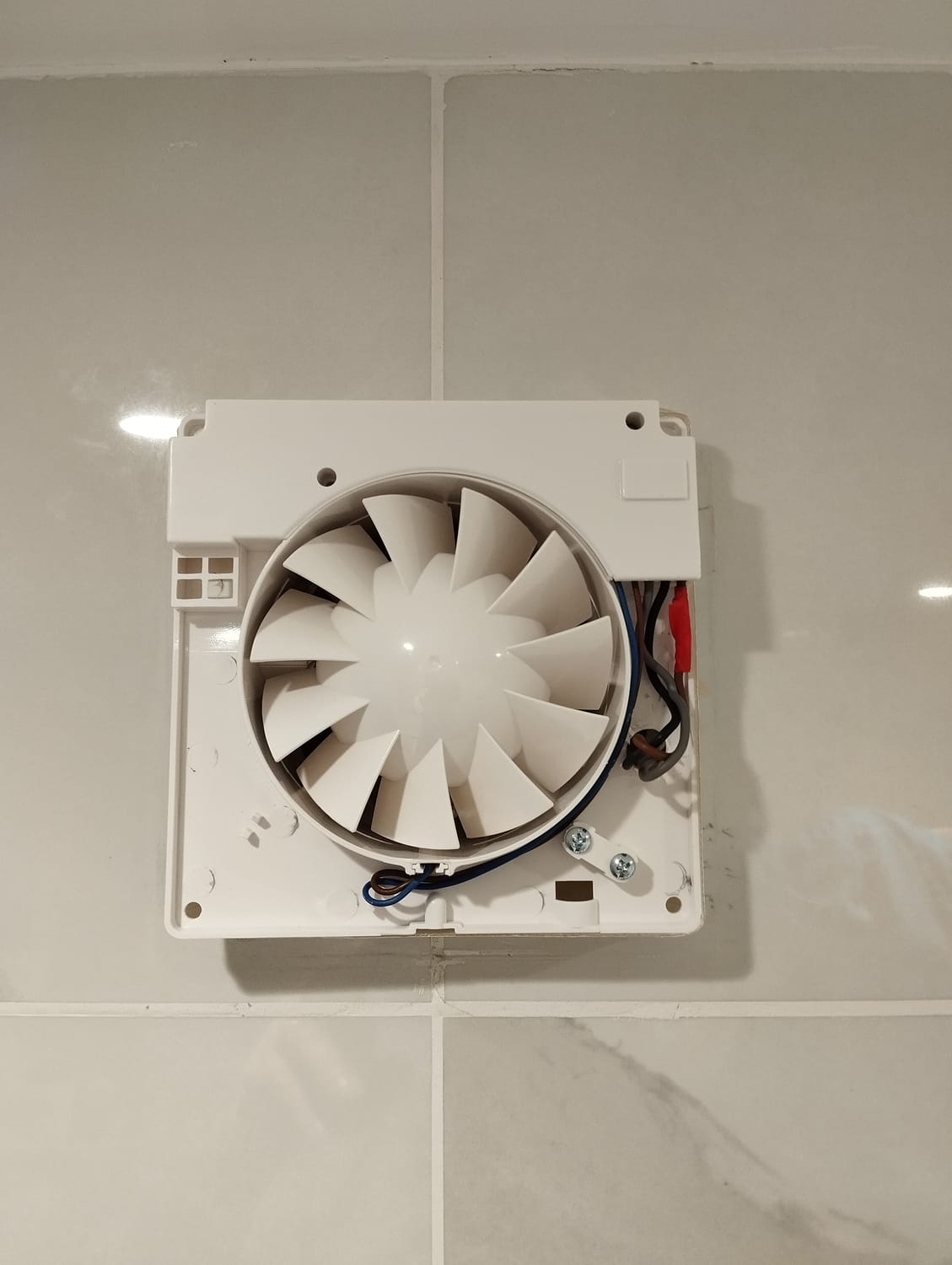
What It actually costs to fix
(2026 UK prices)
Based on what I charge in South London and what I see other qualified tradespeople charging:
DIY Fix (If You're Competent with Electrics)
Materials needed:
Timer fan (£35-60)
External cowl if needed (£8-15)
Duct sealant (£5)
Silicone sealant (£6)
Total materials: £54-86
Your time: 2-4 hours depending on experience
Skill level needed: Basic electrical, understanding Part P
Risk: If you get wiring wrong, you're liable
When DIY makes sense:
You're confident with electrics
It's like-for-like replacement
Wiring is accessible and sound
You have the right tools
Professional Installation (What I Charge)
Supply and fit timer fan: £150-180 Includes:
New timer fan (good quality)
All materials and fixings
Testing and adjustment
12-month guarantee on workmanship
Time: 90-120 minutes
What you get: Compliant installation, properly tested, Full Replacement (When Ducting Needs Work)
New fan + re-route ducting: £250-400
Includes:
New timer fan
New ducting (rigid where possible)
External vent and cowl
Core drill through wall if needed
Making good (filling, painting touch-up)
Time: 3-5 hours depending on access
Why it costs more: Cutting through walls, running new duct, making good
Worst Case (Mould treatment + New ventilation)
Professional mould treatment + ventilation fix: £500-800
Includes:
Professional mould kill treatment
Surface cleaning and treatment
New ventilation system
Anti-mould paint
Time: 1 full day
Reality: Much cheaper than ignoring it for another year
Tools & Materials (Amazon)
We are not affiliated, endorsed, or sponsored by Amazon or any other organisation.
If you're doing this yourself and you're competent:
Essential Tools:
Wera Kraftform Screwdriver Set (from £35 on Amazon)
You'll need this for fan removal and terminal connections
Proper electrician's screwdrivers, not cheap ones
Fluke T90 Voltage Tester (from £45 on Amazon)
Safety first—test everything is dead before touching
Worth every penny
100mm Hole Saw Kit (£25 on Amazon)
If you need to cut new ducting holes
Get a good quality one
CT1 Silicone Sealant (£12 on Amazon)
Best sealant I've used in 20 years
Sticks to anything, stays sealed
Materials You Need:
Manrose MF100T Timer Fan (£42 on Amazon)
My go-to for 80% of installations
Reliable, adjustable, quiet
100mm Flexible Ducting (£8/metre on Amazon)
Get quality ducting, not the cheap thin stuff
Rigid is better where possible
External Vent Cowl - 100mm (£8 on Amazon)
Must have backdraft shutter
White or brown to match exterior
Aluminium Duct Tape (£6 on Amazon)
Not fabric tape—aluminium foil type
Seals duct joints properly
Don't Cheap Out On:
The fan itself (timer is essential)
The ducting quality (cheap ducting splits)
The external vent (needs backdraft shutter)
Your tools (cheap screwdrivers round off screws)
Where You Can Save Money:
Use existing wiring if it's sound
Use existing duct route if it's good
Shop around for delivery (often free over £20)
Do the painting touch-up yourself
The mould risk
(What happens if you ignore this)
I need to be very clear because I've seen what happens:
Timeline of bathroom mould:
Weeks 1-2: Tiny black spots appear in ceiling corners
Weeks 3-4: Spots spread across ceiling in patches
Month 2: Black patches cover 30-40% of ceiling, smell starts
Month 3: Mould spreads to walls, grout lines, silicone sealant
Month 4-6: Paint starts peeling, structural damage begins
Month 6-12: Health effects start (breathing, allergies)
Year 2+: Ceiling replacement needed (£800-1,200)
Real example: Customer in Penge ignored bathroom mould for 18 months. By the time she called me, the ceiling plasterboard was saturated and soft. We had to replace the entire ceiling, treat all the joists with fungicide, plaster, and paint.
Total cost: £1,200
Original fan fix cost: £180
She paid 8 times more by waiting.
Worse?
Her two kids had developed breathing problems. Doctor asked about damp at home.
That's when she finally called me.
My old mentor used to say:
"Share what you know while you can. One day, you’ll understand that teaching others is how we leave something behind."
I'm sharing this so you don't make the same expensive mistake she did.
When to call a professional
(Honest advice)
I'm going to be straight with you:
Call a professional if:
You're not confident with electrical work
The fan is ceiling-mounted (not wall)
You need to run new ducting through walls
You need Part P certification for selling/renting
The existing wiring looks dodgy or old
You've already got mould (needs treating first)
You're not sure what you're doing
You can probably DIY if:
It's a simple like-for-like wall fan replacement
Wiring is accessible and in good condition
You understand basic electrical work
You're competent with tools
You're willing to take responsibility
I'm not trying to talk you out of DIY. I learned by doing it myself. But I also learned by fixing my own mistakes, and some of those mistakes were expensive.
If you're unsure, spend £60 on a professional assessment before you spend £200 on materials and tools you might not need.
Your next steps
(What to actually do)
Step 1: Check your current fan (2 minutes)
Turn your bathroom light off. Does the fan keep running?
If NO → You have a problem
If YES → Time how long it runs (should be 15-20 minutes minimum)
Step 2: Calculate your bathroom size (3 minutes)
Measure length × width in metres. For example: 2m × 2.5m = 5m²
You need minimum 15 litres/second extraction for that 5m² bathroom
.
Step 3: Check your ducting (5 minutes if accessible)
Can you see where your duct goes? Check:
Is it kinked or bent sharply? (Bad)
Does it go outside through a wall? (Good)
Does it go into your loft? (Bad)
Is it long and flexible? (Less effective)
Is it short and rigid? (More effective)
Step 4: Decide your next move
Option A: Book a property Health check from (£80)
I'll assess your ventilation properly
Check if it's compliant with Building Regs
Identify all issues
Give you written report
Quote for fix if needed
Option B: DIY replacement
Buy proper timer fan (£42+)
Follow manufacturer instructions carefully
Test thoroughly
Accept responsibility
Option C: Professional Installation (£150-180)
I supply and fit proper fan
Test
12-month guarantee
Part P certificate provided
My honest recommendation?
If you've got mould already, call someone.
Don't mess about—mould gets worse fast.
If your fan just needs upgrading and you're handy, DIY might work. But get it certified afterwards if you're renting or selling.
If you're unsure, spend £60 - £80 on an assessment. I'll tell you exactly what needs doing and what it'll cost.
No surprises.
Property health check
(The smart investment)
Here's what I've learned after 20 years: small problems become big problems if you ignore them.
That's why I started offering Property Health Checks. For £60, I spend 45 minutes going through your property looking for issues before they become expensive.
(This is a visual maintenance inspection only and does not replace legally required compliance certificates.)
What I check:
Ventilation (bathrooms, kitchen, whole house)
Visible damp or condensation
Electrical safety concerns
Plumbing leaks or problems
Door and window operation
Anything else you're concerned about
What you get:
Written report of findings
Prioritized list (urgent vs. can wait)
Cost estimates for any work needed
Advice on DIY vs. professional
Photos of any issues found
from £120 inspection
If work proceeds within 14 days → credit £40 only.
Landlords love this. I check their properties annually. Catches small issues before tenants complain. Saves thousands.
Homeowners use it before selling. Fix issues before they show up on buyer's survey. Avoids price negotiations.
Investors use it before buying. I've saved people from buying properties with £10,000+ of hidden problems.
One customer in Norwood nearly bought a "perfect" renovation. I spotted that all the electrics were DIY, ventilation was non-compliant, and there were three hidden leaks. He walked away. Saved himself at least £15,000 in fixes.
🚫 What It Does NOT Include:
This inspection:
Is visual only
Does not include electrical certification
Does not include gas safety checks
Does not replace EICR or Gas Safety Certificate
Does not include invasive investigation
Book a Property Health Check:
Email: lovelofters@gmail.com
Website: Lovelofters.com
Final Thoughts
Your bathroom fan stopping with the light isn't just annoying. It's creating a mould problem that'll cost you hundreds or thousands to fix if you ignore it.
I've fixed this exact problem hundreds of times. The solution is simple: install a timer fan properly. Cost: £180 professionally installed, or £50 in materials if you DIY.
Don't wait until you've got black mould everywhere. Fix it now while it's cheap and easy.
And if you're not sure what to do, book a Property Health Check. I'll assess everything properly and tell you exactly what needs doing.
One of my mentors once told me:
"Quality takes a little extra time, but it leaves a lasting impression. The care you put into your work today shapes how people see you tomorrow.”
I prefer to be known for doing things properly. That's why I'm taking the time to explain this to you.
Do it properly, do it once, and never worry about bathroom mould again.
Need help with your bathroom ventilation?
Book a Property Health Check today from £80

I'm Emanuel, the person behind Lovelofters.
I've been working as a professional handyman for 20+ years.
Qualifications: - NVQ Level 2 (General Maintenance) - City & Guilds Level 3 (18th Edition Electrical) - 20+ years professional experience I learned my trade working in luxury hotels and adapting homes for families with disabled children.
Now I help homeowners, landlords, and investors across Crystal Palace, Dulwich, and South London.
My mentor always said: "Be known for expert work, not rushed work." That's still how I operate today.
📍 Based in Crystal Palace, serving South London
📧 info@lovelofters.com
Worried about hidden issues in your property? Not sure if that problem is serious? Want to catch small issues before they become expensive repairs?
I offer comprehensive Property Health Checks for:
✓ Homeowners (identify problems early)
✓ Buyers (before you exchange contracts)
✓ Landlords (annual inspections)
✓ Investors (pre-purchase assessments)
What's included:
- 45-90 minute on-site inspection
- Written report with photos
- Priority list (urgent vs. can wait)
- Cost estimates for any work needed
- Expert advice on DIY vs. professional
- Follow-up call to discuss findings
Pricing:
- 1-2 bed flat: £100
- 2-3 bed house: £150
- 4-5 bed house: £200
£60-150 fee CREDITED if you book any work with me
Recent results:
✓ Saved buyer £18,000 (found hidden problems)
✓ Prevented investor from buying property with £90k work needed
✓ Landlord caught £3,500 issue early (only cost £400 to fix)
📧 Email: Lovelofters@gmail.com
🌐 Lovelofters.com
Based in Crystal Palace, I regularly work across:
📍 Crystal Palace (SE19)
📍 Dulwich (SE21, SE22)
📍 Sydenham (SE26)
📍 Norwood (SE19, SE25)
📍 Penge (SE20)
📍 Croydon
📍 Forest Hill (SE23)
📍 Herne Hill (SE24)
Most assessments scheduled within 48 hours. Same-week
appointments usually available.
Not sure if I cover your area? Contact - I serve most of South London
✓ NVQ Level 2 - General Maintenance
Nationally recognized qualification for professional tradespeople
✓ City & Guilds Level 3 - 18th Edition
Electrical installations to current BS 7671 standards
✓ 20+ Years Professional Experience
From luxury hotels to family homes across London
✓ DBS Checked (Enhanced)
Safe to work in your home with complete peace of mind
What Customers Say
⭐⭐⭐⭐⭐ 5.0 Rating
Based on 47+ verified Reviews
"Finally, someone who actually shows up when they say they will. Emanuel explained everything clearly, no jargon, and the TV mounting looks perfect. Wish I'd called him first instead of wasting time with cowboys."
— Sarah M., Dulwich
---
"I nearly bought a property with £18,000 of hidden problems. Emmanuel pre-purchase inspection saved me from making the biggest financial mistake of my life."
— James T., Property Investor, Crystal Palace
---
"Our bathroom mould kept coming back no matter what we tried. Emmanuel explained it was ventilation, not damp. Fixed it properly. Six months later, not a single spot of mould. Finally solved."
— The Patel Family, Sydenham
---
[Read + More Reviews →]
When you work with me, you get:
✓ 12-Month Workmanship Guarantee
If there's a problem with my work, I'll come back and fix it. No arguments.
✓ Transparent Pricing
Written quote before work starts. No hidden fees. No surprises.
✓ Clean Workspace Promise
Dust sheets down, cleanup included, your home treated with respect.
✓ Full Certification
Electrical Safety Certificates, Building Regulations compliance documentation provided.
✓ Same-Week Appointments
Most jobs scheduled within 7 - 10 days. Assessments usually within 48 hours.
✓ Honest Assessment
I'll tell you what actually needs doing and what doesn't. No upselling.
If I can't help, I'll tell you who can.
If it's something you can DIY safely, I'll teach you how.
Related Articles You Might Find Helpful
📖 [Why Your Bathroom Extractor Fan Stops When the Light Turns Off]
Black mould spreading? Your fan setup might be creating the problem. Here's what's actually happening...
📖 [7 Things to Check Before Buying a Property]
Don't make the expensive mistakes most first-time buyers miss. I've saved clients £18,000+ with these checks...
📖 [10 Home Maintenance Tasks That Prevent £5,000 Repairs]
Simple tasks most people ignore until it's too late. The £30 gutter clean that prevents £2,800 damp damage...
[View All Home Maintenance Articles →]
Join 300+ South London homeowners getting honest advice delivered every month:
✓ Seasonal maintenance reminders (before problems start)
✓ Cost-saving tips and tricks from 20 years experience
✓ Early warning signs of expensive problems
✓ Honest advice on DIY vs. when to hire a professional
Plus: Instant access to my FREE 20-page Home Maintenance Checklist
COMING SOON
No spam ever. Unsubscribe anytime with one click. I respect your inbox.
See my latest projects, maintenance tips, and behind-the-scenes:
📷 Instagram: [@lovelofters_handyman](https://instagram.com/lovelofters_handyman)
📌 Pinterest: [/lovelofters](https://pinterest.com/lovelofters)
Home maintenance guides, checklists, and visual how-tos
⭐ Google Reviews: [Leave a Review]
Help other South London homeowners find reliable help

The information in this article is based on my 20+ years of professional experience and current UK Building Regulations. While I strive for accuracy, building codes and best practices can change.
Always verify current regulations with your Local Authority Building Control or a qualified professional before starting any work.
Important:
- For electrical work: Always use a qualified electrician or Part P certified professional
- For gas work: Always use a Gas Safe registered engineer (it's the law)
- For structural work: Always consult a structural engineer
Affiliate Disclosure:
This article may contain affiliate links to products and tools I genuinely recommend. If you purchase through these links, I may earn a small commission at no additional cost to you. I only recommend products I actually use myself or would use in my own home.
© 2026 Lovelofters Handyman. All rights reserved.
Read also
Simple maintenance tasks most people ignore until it's too late. I've seen the damage. Here's what to do monthly, seasonally, and annually to avoid expensive repairs.
Buying a property? I've inspected hundreds. Here are the 7 things most buyers miss that cost thousands later. Independent pre-purchase inspections available.
[← Back to Blog]

Professional handyman services across South London.
20+ years experience. Work done properly, not quickly.
NVQ L2 • City & Guilds L3 • DBS Checked
Quick links
Newsletter
Get monthly home maintenance tips and advice from 20+ years experience.
Join South London homeowners No spam. Unsubscribe anytime.
© 2026 Lovelofters Handyman. All rights reserved.
Privacy Policy | Terms of Service | Cookie Policy
Created with ©systeme.io